Home / Blog / Step-by-Step Guide to Operating a BET Adsorption Analyzer for Accurate Results
Step-by-Step Guide to Operating a BET Adsorption Analyzer for Accurate Results
14 5 月, 2026From: BSD Instrument
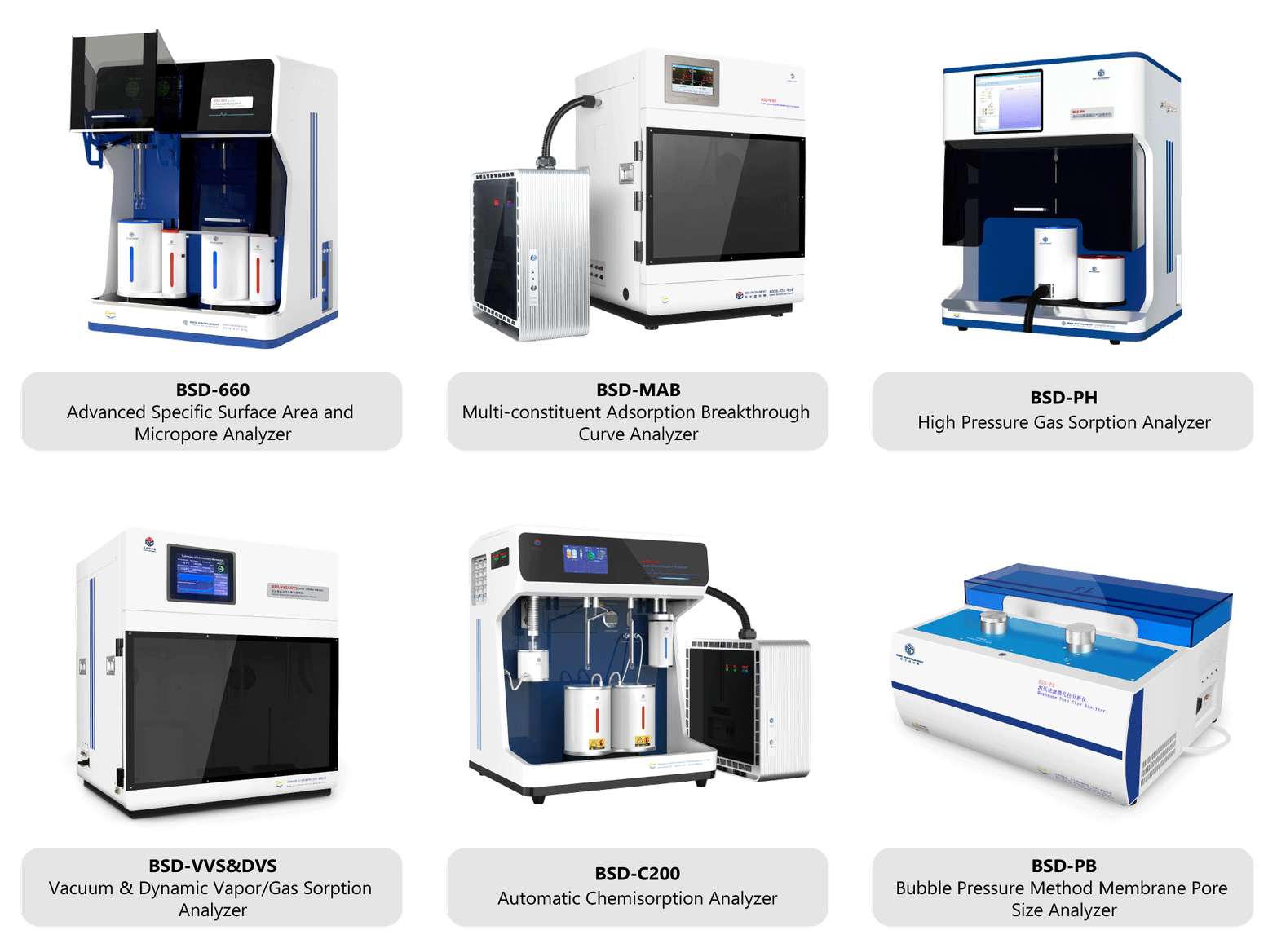
BET Adsorption Analyzer method is the gold standard for determining the specific surface area of powders and porous materials. However, the accuracy of the results heavily depends on strict adherence to operational protocols, particularly regarding sample preparation and degassing. This guide outlines the standard operating procedure to ensure reliable and reproducible BET measurements.
1. Pre-Operation: Instrument Preparation & Calibration
Before handling samples, ensure the analyzer is ready for precise measurement:
- Gas Supply: Turn on the nitrogen (adsorbate) and helium (for dead volume calibration, if applicable) cylinders. Adjust the regulator pressure to the manufacturer’s recommended working pressure (typically 0.1–0.2 MPa) .
- Power Up: Switch on the vacuum pump, the analyzer main unit, and the control computer. Allow the thermal conductivity detector (TCD) or pressure transducers to warm up and stabilize (usually 30 minutes) .
- System Check: Perform a leak check and calibrate the saturation pressure (). Verify the instrument’s accuracy using a certified reference material (CRM) with a known surface area (e.g., silica or alumina). The measured value should fall within of the certified value .
2. Sample Preparation
Accurate weighing and pretreatment are critical to avoid systematic errors:
- Sample Mass: Weigh an appropriate amount of the dry sample into a clean sample tube. The mass depends on the estimated surface area:
- High surface area (): 50–200 mg.
- Low surface area (): 0.5–2 g.
- Rule of thumb:Aim for a total surface area of 15–20 per tube to ensure a strong signal .
- Particle Size: Ensure the sample is finely ground (particles ) to avoid internal mass transfer limitations, but avoid overly fine powders that may be lost during vacuuming .
- Pre-weighing: Record the exact weight of the sample (tube + sample - tare weight) to a precision of at least 0.1 mg .
3. Sample Degassing (The Most Critical Step)
Degassing removes physisorbed water, solvents, and other contaminants from the pore surfaces. Incomplete degassing is the primary cause of inaccurate (usually low) BET results.
- Mounting: Secure the sample tube (often with a glass wool plug or frit to prevent sample loss) into the degas station or a separate vacuum oven .
- Parameter Setting: Set the degassing temperature and time.
- Temperature:Must be below the sample's phase transition or decomposition point (generally the melting point). Common ranges are 105–150°C for standard materials, up to 300°C for robust ceramics .
- Time:Typically 2–6 hours (or overnight at lower temps) until the vacuum pressure stabilizes, indicating no more volatiles are evolving .
- Execution: Apply vacuum and heat. Once completed, allow the sample to cool to room temperature under vacuumbefore venting slowly (usually with dry nitrogen or helium) to prevent immediate re-adsorption of ambient moisture .
- Post-weighing (Optional but Recommended): Weigh the tube again after degassing to account for any mass loss (e.g., loss of volatiles), though many operators use the pre-degassing mass if the loss is negligible .

4. Analysis Setup
- Transfer: Carefully transfer the degassed sample tube to the analysis port of the BET instrument. If using a filling rod (to reduce dead volume), insert it now. Ensure the seal is tight to prevent leaks .
- Liquid Nitrogen: Fill the Dewar flask with liquid nitrogen (LN₂). Ensure the level is sufficient to submerge the sample bulb completely and remains stable throughout the run .
- Software Configuration: Input the exact sample mass, select the adsorbate (N₂), and define the analysis parameters:
- Relative Pressure Range (): For BET calculation, ensure points cover the 0.05–0.35 range (typically 5–7 points) .
- Equilibrium Mode: Choose between continuous flow or fixed time intervals based on the sample's adsorption kinetics (porous materials may require longer equilibrium times) .
5. Running the Test & Data Acquisition
- Start the analysis via the software. The instrument will typically:
- Perform a dead volume measurement (often using He).
- Lower the LN₂ Dewar to immerse the sample (cooling to 77 K).
- Introduce doses of adsorbate gas at increasing values, measuring the equilibrated pressure to calculate adsorbed quantity.
- Optionally perform a desorption branch by decreasing .
- Monitor the initial points to ensure the system is stable and no leaks are present.
6. Data Processing & Validation
Once the isotherm is generated:
- BET Plot: The software automatically plots vs. .
- Linearity Check: Select the linear region (usually ). A valid BET analysis requires a correlation coefficient () (or per some stricter SOPs). If is low, the data or the selected range may be invalid .
- Calculation: The software calculates the monolayer adsorbed volume () from the slope and intercept, and subsequently the specific surface area () using the formula:Where is Avogadro's number, is the cross-sectional area of N₂ (0.162 nm²), is the molar volume, and is the sample mass .
7. Shutdown Procedure
- Remove the sample tube and Dewar. Allow the sample tube to warm to room temperature before opening to avoid condensation.
- Clean the sample tube thoroughly (wash with solvent, dry, or bake out) for the next use .
- Close the gas cylinder valves, shut down the software, turn off the instrument, and finally the vacuum pump.
- Record the usage in the logbook .
Share:


Our Latest Blog & Articles
Stay updated with our latest news. Discover new product launches, innovative technologies, and upcoming events. Join our community and stay informed about all things lab equipment.
-
16 9 月, 2026
Organic Vapor Adsorption on Activated Carbon: Pore Structure, Surface Chemistry, and Breakthrough Behavior
-
25 8 月, 2026
Overcoming Thermal Transpiration Effects in Volumetric Adsorption Analyzer for Ultra-Micropore Characterization
-
21 7 月, 2026
Integrating Machine Learning Algorithms with Micropore Analyzer Data for Rapid Pore Size Distribution Prediction
-
26 6 月, 2026
Gas Sorption vs. Mercury Intrusion: Which Pore Size Analyzer Technique Is Right for You?