Home / Product / BSD...

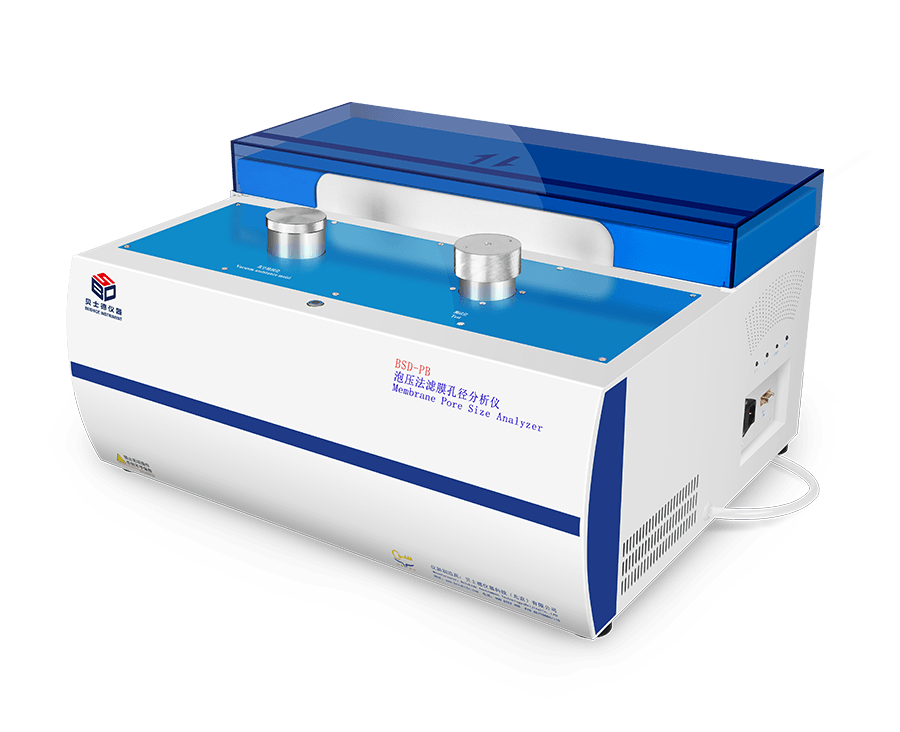
BSD- PBL Membrane Pore Size Analyzer Liquid-Liquid

The PB Membrane Pore Size Analyzer utilizes the gas-liquid or liquid liquid displacement method (bubble pressure method) to accurately measure the pore size characteristics of membrane materials. By applying a pressure difference across the membrane, the system overcomes the surface tension of the infiltration liquid, driving it through the pores to determine pore throat sizes. This method is the standard for ASTM thin film pore size testing. The analyzer is widely used for pore size analysis in materials such as filter membranes, fiber membranes, filter elements, battery separators, fabrics, non-woven fabrics, paper, ceramics, sintered metals, rocks, concrete, and more.

facebookLinkedintwitterskypewhatsapp
Main Function
  • Bubble point pressure

  • Wet membrane flow–pressure curve (wet curve)

  • Bubble point pore diameter (maximum pore size)

  • Dry membrane flow–pressure curve (dry curve)

  • Minimum pore size

  • Gas permeability

  • Mean pore size

  • Gas flux

  • Most probable pore size

  • Integrity evaluation

  • Pore size distribution

  • Fiber membrane burst pressure

  • Liquid permeability (liquid–liquid method)

  • Transverse gas diffusion performance evaluation

  • Liquid flux (liquid–liquid method)

Technical Parameter
  • Pore size measurement range:
    Standard model: 0.012 µm–500 µm (gas–liquid displacement method); 5nm-50nm (liquid-liquid displacement method);

  • Multiple sample cell configurations are available for samples of different sizes; custom-designed sample cells can be provided for special samples;

  • Equipped with a fully automatic vacuum-assisted wetting system, which significantly accelerates the wetting process and improves test efficiency by more than 50%;

  • Multiple wetting liquids available depending on the sample under test, including dedicated wetting liquid BSD-16 or other compatible wetting liquids;

  • High-precision dual flow sensors with segmented flow measurement, complementary measurement ranges, and automatic range switching;

  • High-precision dual pressure sensors with segmented pressure measurement; the system automatically determines and switches the appropriate pressure range via software control;

  • All-stainless-steel tubing with metal-to-metal hard sealing, providing excellent gas tightness, high pressure resistance, and corrosion resistance.
img
File not exist! Data Sheet

Key Feature

Feature Icon

5 nm to 50 nm and 0.012 µm to 500 µm

Precise pore size measurement using both gas-liquid and liquid-liquid displacement method.

Feature Icon

Dual Pressure Sensors

Segmented pressure measurement with complementary ranges for enhanced accuracy.

Feature Icon

Dual Flow Sensors

Segmented flow measurement with automatic program switching for optimal performance.

Feature Icon

Vacuum-Assisted Wetting

Fast, efficient sample infiltration that improves wetting efficiency and simplifies operation.

Feature Icon

Versatile Sample Pool

Adapts to various membrane sizes and types for flexible testing.

Feature Icon

Bubble Pressure Method

Through-Hole Aperture:** ASTM-compliant method for measuring film pore sizes.

Image
Engineering In Situ Catalytic Cleaning Membrane ViaPrebiotic-Chemistry-Inspired Mineralization Xiaobin Yang, Yajie Wen, Yangxue Li, Linlin Yan, Chuyang Y. Tang, Jun Ma, Seth B. Darling,* and Lu Shao*

Pressure-driven membrane separation promises a sustainable energy-water nexus but is hindered by ubiquitous fouling. Natural systems evolved from prebiotic chemistry offer a glimpse of creative solutions. Herein, a prebiotic-chemistry-inspired aminomalononitrile (AMN)/Mn2+-mediated mineralization method is reported for universally engineering a superhydrophilic hierarchical MnO2 nanocoating to endow hydrophobic polymeric membranes with exceptional catalytic cleaning ability. Green hydrogen peroxide catalytically triggered in-situ cleaning of the mineralized membrane and enabled operando flux recovery to reach 99.8%. The mineralized membrane exhibited a 9-fold higher recovery compared to the unmineralized membrane, which is attributed to active catalytic antifouling coupled with passive hydration antifouling. Electron density differences derived from the precursor interaction during mediated mineralization unveiled an electron-rich bell-like structure with an inner electron-deficient Mn core. This work paves the way to construct multifunctional engineered materials for energy-efficient water treatment as well as for diverse promising applications in catalysis, solar steam generation, biomedicine, and beyond.