Home / Blog / Overcoming Thermal Transpiration Effects in Volumetric Adsorption Analyzer for Ultra-Micropore Characterization
Overcoming Thermal Transpiration Effects in Volumetric Adsorption Analyzer for Ultra-Micropore Characterization
25 8 月, 2026From: BSD Instrument
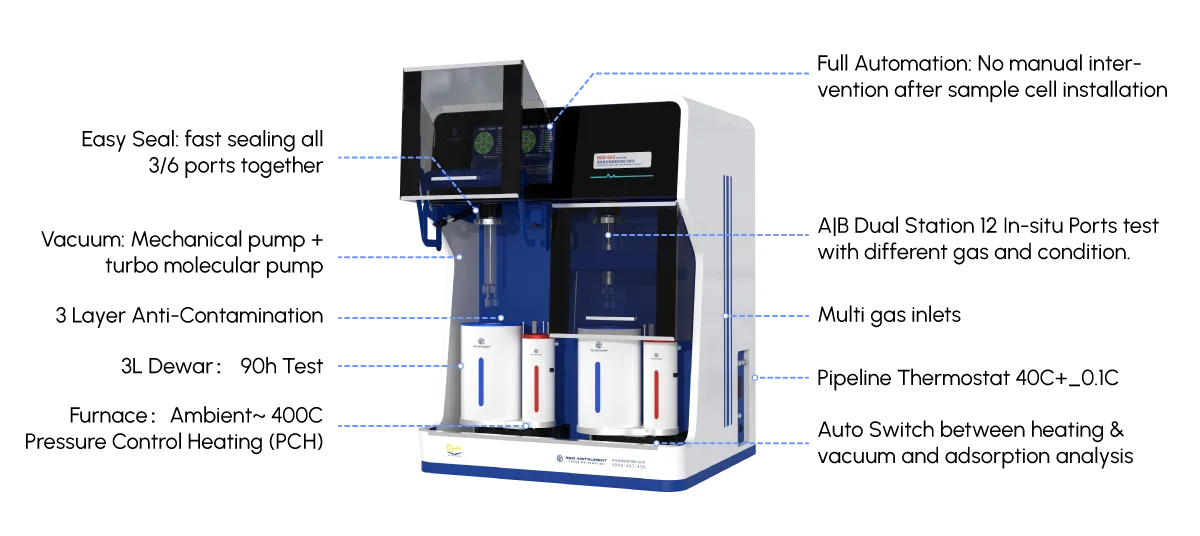
Abstract:
The accurate characterization of ultra-micropores (pores < 1 nm) is critical for advances in gas storage, catalysis, and molecular sieving. While volumetric physisorption analyzers are the gold standard for textural analysis, they face a significant physical challenge in the low-pressure regime: Thermal Transpiration (TT) . This article explores the nature of thermal transpiration, its detrimental impact on isotherm measurement, and the robust methodologies—both instrumental and mathematical—that modern laboratories employ to overcome this obstacle.
1. The Challenge at the Nanoscale
As the demand for advanced porous materials—such as Metal-Organic Frameworks (MOFs), Zeolitic Imidazolate Frameworks (ZIFs), and activated carbons—increases, so does the need for precise characterization of pores below 1 nanometer (ultra-micropores).
The assessment of these pores relies heavily on the low-pressure region of the adsorption isotherm (often in the relative pressure range of 10−7 to 10−3 P/P₀). At these extreme vacuums, a physical phenomenon known as thermal transpiration can render conventional pressure readings inaccurate, leading to erroneous pore size distributions (PSDs) calculated by Density Functional Theory (DFT).
2. Understanding Thermal Transpiration
Thermal transpiration, also known as the "thermomolecular pressure effect," occurs in a gas when there is a temperature gradient between two connected regions.
The Physics:
When a gas is in the "free molecular" or "transition" flow regime—where the mean free path of the gas molecules is large relative to the diameter of the connecting tube—molecules move independently of each other. If the two regions are at different temperatures (e.g., the gas manifold at ambient temperature vs. the sample tube immersed in a cryogenic bath), a pressure gradient is established.
In the cold zone (sample tube), molecules have lower kinetic energy.
In the hot zone (manifold), molecules have higher kinetic energy.
To maintain equilibrium, the number density (n) adjusts so that the pressures are unequal, defined by the equation:
PcoldPhot=TcoldThot
This means the pressure measured by the transducer in the hot manifold is higher than the actual pressure in the cold sample tube.
Why it Matters:
If uncorrected, this effect leads to a systematic shift in the isotherm:
The "knee" of the isotherm appears at apparently higher relative pressures.
Pore filling in ultra-micropores appears to occur at pressures higher than the true thermodynamic equilibrium.
This results in a calculated pore size that is smaller than reality, or the complete misidentification of pore structures.
3. Instrumental Strategies for Mitigation
Modern high-performance volumetric analyzers incorporate specific engineering solutions to minimize or eliminate TT effects.
A. The Constant-Volume "Cold" Manifold
Some advanced instruments utilize a pressure transducer located directly within the cryogenic zone (or isolated at the same temperature). By measuring the pressure locally at the sample temperature, the thermal transpiration error is physically eliminated because Tcold equals the measurement temperature.
B. Tube Geometry Optimization
TT effects are geometry-dependent. In the transition flow regime, the magnitude of the effect depends on the radius (r) and length (L) of the connecting tube, as well as the pressure. By using large-diameter, short connecting tubes, the instrument shifts the "critical pressure" lower, ensuring the system remains in the viscous flow regime (P⋅d>0.1 Torr·cm), where TT effects are negligible.
C. Isothermal Enclosures
Placing the entire gas handling manifold and sample tube within a temperature-controlled enclosure reduces the steepness of the temperature gradient. While this doesn't remove the effect entirely, it stabilizes the environment, allowing for more reliable mathematical corrections.
4. Mathematical Correction Factors
Where hardware modifications are insufficient, mathematical correction factors are applied. The most widely accepted approaches rely on the work of Takaishi and Sensui and the Weber and Roon formulations.
The Correction Procedure:
Pressure Ratio: The true pressure in the cold zone (Pcold) is calculated by multiplying the measured manifold pressure by a correction factor (KTT).
The Takaishi-Sensui Equation: This model determines KTT based on the Knudsen number, accommodating the transition from viscous to molecular flow.
KTT=PcoldPhot=1+α⋅Kn1+β⋅Kn
(Where Kn is the Knudsen number, and α and β are constants related to gas accommodation coefficients).
Implementation in Software:
Modern software packages (like Micromeritics Smart DFT or Anton Paar’s Klotz) now integrate these corrections automatically. However, a validation step is crucial: the operator must confirm the pressure drop across the isotherm. The correction is most significant at very low pressures; at pressures exceeding 1 Torr, the effect tends to vanish.
5. Best Practices for the Analyst
Successfully overcoming TT is not just about having the right software; it requires a methodological approach.
Define the Equilibrium Time: In the ultra-micropore region, adsorption is activated. Use longer equilibrium times to ensure physical adsorption is complete, allowing you to differentiate between kinetic limitations and TT-induced pressure reading errors.
Validate with a Standard: Run a reference material (e.g., standard alumina or carbon black) with known ultra-micropore characteristics under the exact same conditions. Compare the PSD with accepted literature values.
Set the Low-Pressure Dose Volume: Reduce the dosing volume (the dead space volume) in the ultra-low pressure range. Smaller doses help maintain the required accuracy by ensuring pressure rises are large enough to be measured accurately, even with the TT correction applied.
6. Conclusion
Thermal transpiration is a formidable challenge in the characterization of ultra-micropores, but it is not insurmountable. The combination of advanced instrument hardware (cold transducers, optimized geometry) and rigorous mathematical algorithms (Takaishi-Sensui corrections) allows modern volumetric analyzers to produce accurate, reliable isotherms down to 10−8 Torr.
For the researcher, awareness is key. By adopting best practices—validating standards, optimizing equilibration times, and understanding the physical limits of the system—the community can ensure that the next generation of porous materials is characterized with fidelity, paving the way for breakthroughs in carbon capture, hydrogen storage, and chemical separation.
Share:


Our Latest Blog & Articles
Stay updated with our latest news. Discover new product launches, innovative technologies, and upcoming events. Join our community and stay informed about all things lab equipment.
-
16 9 月, 2026
Organic Vapor Adsorption on Activated Carbon: Pore Structure, Surface Chemistry, and Breakthrough Behavior
-
25 8 月, 2026
Overcoming Thermal Transpiration Effects in Volumetric Adsorption Analyzer for Ultra-Micropore Characterization
-
21 7 月, 2026
Integrating Machine Learning Algorithms with Micropore Analyzer Data for Rapid Pore Size Distribution Prediction
-
26 6 月, 2026
Gas Sorption vs. Mercury Intrusion: Which Pore Size Analyzer Technique Is Right for You?