Home / Blog / Advanced Applications of BET Adsorption Instrument in Nanomaterial Characterization
Advanced Applications of BET Adsorption Instrument in Nanomaterial Characterization
16 1 月, 2026From: BSD Instrument
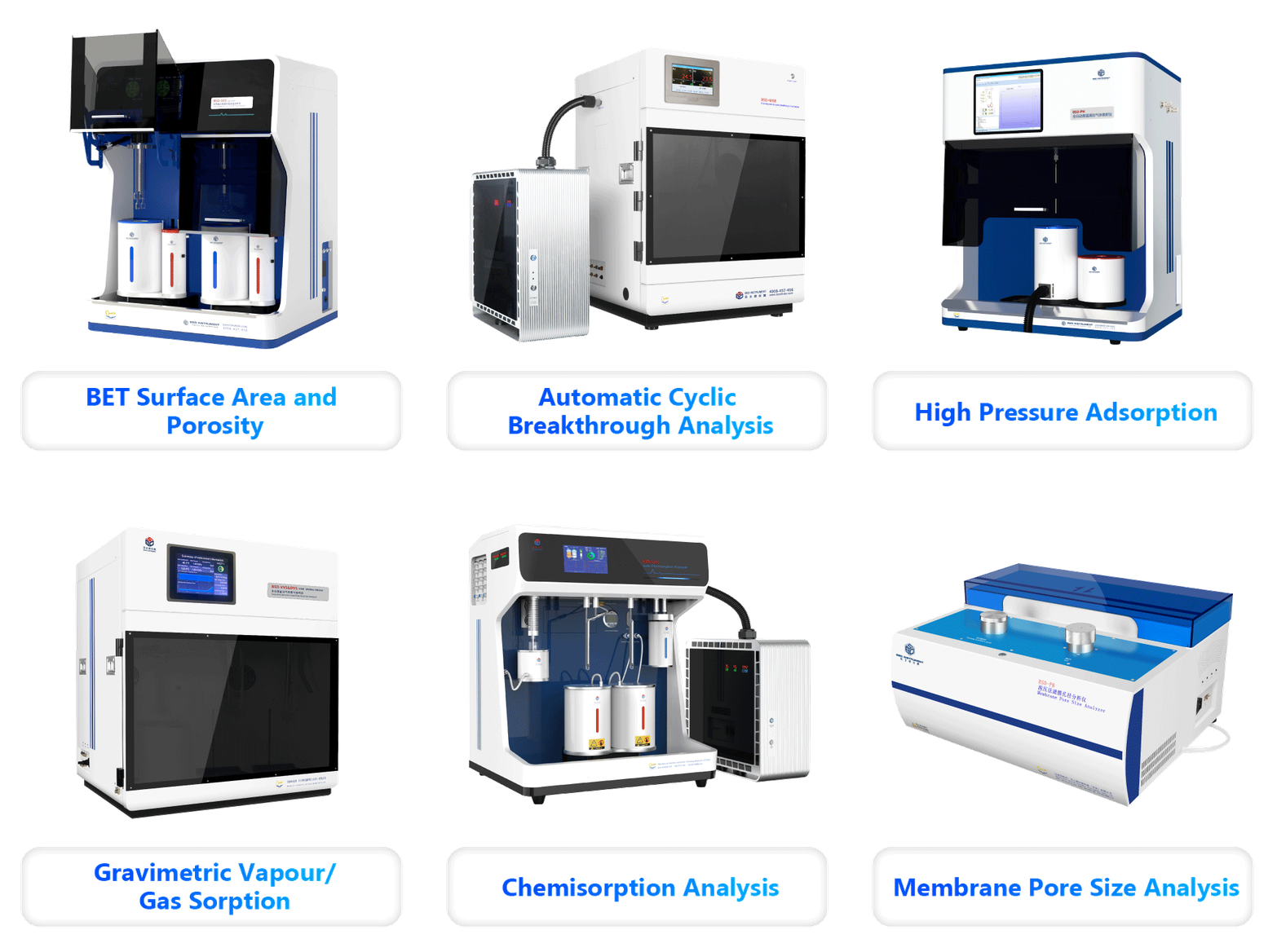
Introduction
The Brunauer-Emmett-Teller (BET) theory, developed in 1938, has long been a cornerstone for characterizing the surface area and porosity of solid materials. With the rise of nanotechnology, where material properties are dominated by nanoscale dimensions (1–100 nm), the BET adsorption instrument—primarily based on nitrogen physisorption at 77 K—has evolved from a basic analytical tool to an indispensable platform for advanced nanomaterial characterization. Its ability to quantify specific surface area, pore size distribution (PSD), and total pore volume provides critical insights into structure-property relationships, enabling researchers to optimize nanomaterials for applications ranging from energy storage to catalysis. This article explores the advanced applications of BET instruments in nanomaterial science, highlighting their role in addressing complex challenges in modern research.
Fundamental Principles: Beyond Basic Surface Area Measurement
At its core, the BET method uses gas adsorption isotherms (typically N₂ at 77 K) to calculate the monolayer capacity () of adsorbate molecules on a material’s surface, from which the specific surface area () is derived using the formula:
where is Avogadro’s number, is the cross-sectional area of the adsorbate molecule (~0.162 nm² for N₂), and is the molar mass of the adsorbate. However, modern BET instruments extend far beyond this basic calculation. They integrate high-resolution pressure transducers (enabling measurements down to 10⁻⁶ Torr), automated dosing systems, and advanced data analysis software to characterize complex porous structures, including micropores (<2 nm), mesopores (2–50 nm), and macropores (>50 nm).
Advanced Application 1: Pore Size Distribution Analysis for Hierarchical Nanomaterials
Hierarchical nanomaterials—those with multiple levels of porosity (e.g., micro-mesoporous or meso-macroporous structures)—are highly sought after for applications requiring both high surface area and efficient mass transport. For example, metal-organic frameworks (MOFs) like ZIF-8 often exhibit uniform microporosity, while hierarchical zeolites combine micropores with mesopores to enhance catalytic activity.
BET instruments address this complexity through physisorption isotherm classification (per IUPAC guidelines) and advanced PSD models:
- Micropore analysis: The t-plot method or Horvath-Kawazoe (HK) model distinguishes between monolayer adsorption and micropore filling, quantifying pore volumes as small as 0.3 nm. For instance, activated carbon nanotubes (CNTs) with embedded micropores show enhanced CO₂ capture due to their ultrahigh micropore surface area (>1500 m²/g).
- Mesopore characterization: The Barrett-Joyner-Halenda (BJH) model, applied to desorption branches of isotherms, resolves mesopore sizes (2–50 nm). This is critical for evaluating mesoporous silica nanoparticles (MSNs) used in drug delivery, where pore size dictates payload encapsulation efficiency.
- Hybrid modeling: Combining density functional theory (DFT) with experimental data allows simultaneous analysis of micro-, meso-, and even macropores. For example, hierarchical TiO₂ photocatalysts synthesized via soft-templating exhibit dual PSD peaks (micropores at ~1.5 nm and mesopores at ~15 nm), correlating with improved visible-light absorption and charge separation.
Advanced Application 2: Specific Surface Area Quantification for Functional Nanomaterials
In nanomaterials, surface area directly governs reactivity, adsorption capacity, and mechanical stability. BET instruments enable precise quantification of surface area for diverse functional nanomaterials:
- Carbon-based materials: Graphene oxide (GO) and reduced GO (rGO) have surface areas of 200–1000 m²/g, depending on oxidation degree and reduction method. BET analysis reveals that rGO with fewer oxygen groups retains higher surface area, enhancing its performance in supercapacitors.
- Metal oxides: Nanoscale TiO₂ (anatase phase) exhibits a surface area of ~50 m²/g, but when synthesized as hollow nanospheres, this increases to >200 m²/g, boosting photocatalytic degradation of organic pollutants.
- 2D materials: Transition metal dichalcogenides (e.g., MoS₂ nanosheets) have surface areas exceeding 600 m²/g, making them ideal for lithium-ion battery anodes. BET measurements confirm that exfoliated MoS₂ nanosheets retain >80% of their theoretical surface area after 500 cycles, outperforming bulk counterparts.
Advanced Application 3: Catalytic Performance Correlation with Porosity
Catalysis relies heavily on active site accessibility, which is dictated by pore structure. BET instruments bridge the gap between porosity and catalytic activity by linking PSD/surface area to reaction kinetics:
- Zeolite catalysts: H-ZSM-5 zeolites with hierarchical porosity (micropores + mesopores) show 30–50% higher conversion rates in methanol-to-olefins reactions compared to purely microporous analogs. BET analysis confirms that mesopores reduce diffusion limitations, allowing reactants to reach internal acid sites more efficiently.
- Supported metal catalysts: Pt nanoparticles supported on ordered mesoporous carbons (OMCs) exhibit superior CO oxidation activity. BET data reveal that OMCs with a narrow mesopore size distribution (~4 nm) maximize Pt dispersion (particle size <2 nm) while minimizing pore blockage, leading to turnover frequencies (TOFs) 2× higher than non-porous supports.
Advanced Application 4: Stability Assessment Under Operational Conditions
Nanomaterials often face harsh environments (e.g., high humidity, elevated temperatures, or reactive atmospheres) that can alter their porosity. Modern BET instruments feature in situ cells capable of measuring adsorption under controlled conditions (temperature: -196°C to 500°C; pressure: up to 100 bar), enabling real-time monitoring of structural changes:
- Battery materials: Silicon nanowire anodes expand by ~300% during lithiation, causing pore collapse. In situ BET measurements track surface area loss over 100 cycles, identifying optimal electrolyte additives that mitigate structural degradation.
- Environmental adsorbents: Metal-organic frameworks (MOFs) like UiO-66 degrade in humid air due to ligand hydrolysis. Isothermal BET tests at 90% relative humidity show a 40% drop in surface area within 24 hours, guiding the development of hydrophobic MOF coatings for water-stable applications.
Limitations and Emerging Trends
While BET instruments are versatile, they have limitations:
- Adsorbate specificity: N₂ adsorption may underestimate surface area for low-surface-energy materials (e.g., graphene) or those with pore sizes below 0.5 nm (requiring Ar or CO₂ physisorption at lower temperatures).
- Sample preparation: Agglomeration of nanomaterials (e.g., CNT bundles) can mask true surface area, necessitating careful degassing protocols.
Emerging trends aim to overcome these challenges:
- Multivariate analysis: Integrating BET data with X-ray diffraction (XRD), transmission electron microscopy (TEM), and positron annihilation lifetime spectroscopy (PALS) enables multiscale characterization of nanomaterials.
- High-throughput automation: Robotic sample handlers now allow simultaneous analysis of 96 samples, accelerating screening of nanomaterial libraries for industrial applications.
Conclusion
The BET adsorption instrument has transcended its traditional role as a surface area analyzer to become a multifunctional platform for advanced nanomaterial characterization. By resolving pore size distributions, quantifying surface area, correlating porosity with catalytic performance, and assessing operational stability, it empowers researchers to design nanomaterials with tailored properties for energy, environmental, and biomedical applications. As nanotechnology continues to evolve, innovations in BET instrumentation—such as in situ capabilities and multivariate integration—will further solidify its position as an indispensable tool in the nanomaterials scientist’s arsenal.
Share:


Our Latest Blog & Articles
Stay updated with our latest news. Discover new product launches, innovative technologies, and upcoming events. Join our community and stay informed about all things lab equipment.
-
16 9 月, 2026
Organic Vapor Adsorption on Activated Carbon: Pore Structure, Surface Chemistry, and Breakthrough Behavior
-
25 8 月, 2026
Overcoming Thermal Transpiration Effects in Volumetric Adsorption Analyzer for Ultra-Micropore Characterization
-
21 7 月, 2026
Integrating Machine Learning Algorithms with Micropore Analyzer Data for Rapid Pore Size Distribution Prediction
-
26 6 月, 2026
Gas Sorption vs. Mercury Intrusion: Which Pore Size Analyzer Technique Is Right for You?