Home / Product / BSD...

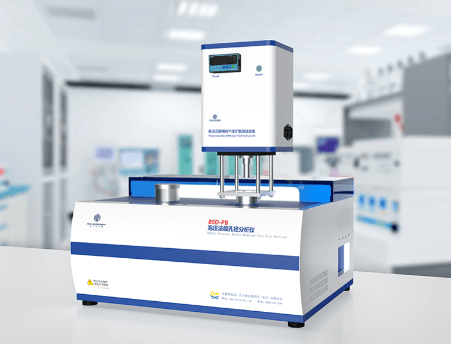
BSD-PBB Bubble Pressure Method Membrane Pore Size Analyzer

The PBB Membrane Pore Size Analyzer utilizes the gas-liquid displacement method (bubble pressure method) to accurately measure the pore size characteristics of membrane materials. By applying a pressure difference across the membrane, the system overcomes the surface tension of the infiltration liquid, driving it through the pores to determine pore throat sizes. This method is the standard for ASTM thin film pore size testing. The analyzer is widely used for pore size analysis in materials such as filter membranes, fiber membranes, filter elements, battery separators, fabrics, non-woven fabrics, paper, ceramics, sintered metals, rocks, concrete, and more.

facebookLinkedintwitterskypewhatsapp
Main Function
  • Bubble point pressure

  • Wet membrane flow–pressure curve (wet curve)

  • Bubble point pore diameter (maximum pore size)

  • Dry membrane flow–pressure curve (dry curve)

  • Minimum pore size

  • Gas permeability

  • Mean pore size

  • Gas flux

  • Most probable pore size

  • Integrity evaluation

  • Pore size distribution

  • Fiber membrane burst pressure

  • Liquid permeability (liquid–liquid method)

  • Transverse gas diffusion performance evaluation

  • Liquid flux (liquid–liquid method)

img
File not exist! Data Sheet

Feature Icon

Dual Pressure Sensors

Segmented pressure measurement with complementary ranges for enhanced accuracy.

Feature Icon

0.12 µm to 500 µm

Precise pore size measurement using gas-liquid displacement method.

Feature Icon

Dual Flow Sensors

Segmented flow measurement with automatic program switching for optimal performance.

Feature Icon

Vacuum-Assisted Wetting

Fast, efficient sample infiltration that improves wetting efficiency and simplifies operation.

Feature Icon

Versatile Sample Pool

Adapts to various membrane sizes and types for flexible testing.

Feature Icon

Bubble Pressure Method

Through-Hole Aperture:** ASTM-compliant method for measuring film pore sizes.

Specifications

SpecificationsDetails
Pore size measurement range0.12 µm–500 µm (gas–liquid displacement method)
Multiple sample cell configurationsMultiple sample cell configurations are available for samples of different sizes; custom-designed sample cells can be provided for special samples;
Fully automatic vacuum-assisted wetting systemEquipped with a fully automatic vacuum-assisted wetting system, which significantly accelerates the wetting process and improves test efficiency by more than 50%;
High-precision dual flow sensorsHigh-precision dual flow sensors with segmented flow measurement, complementary measurement ranges, and automatic range switching;
High-precision dual pressure sensorsHigh-precision dual pressure sensors with segmented pressure measurement; the system automatically determines and switches the appropriate pressure range via software control;
All-stainless-steel tubingAll-stainless-steel tubing with metal-to-metal hard sealing, providing excellent gas tightness, high pressure resistance, and corrosion resistance.
Multiple wetting liquids availableMultiple wetting liquids available depending on the sample under test, including dedicated wetting liquid BSD-16 or other compatible wetting liquids;
Image
A Five Micron Thick Aramid Nanofiber Separator Enables Highly Reversible Zn Anode for Energy-Dense Aqueous Zinc-Ion Batteries Lin Yang, Ying-Jie Zhu,* Han-Ping Yu, Zhong-Yi Wang, Long Cheng, Dan-Dan Li, Jingchao Tao,* Guo He, and Heng Li*

The rampant dendrites growth caused by uncontrolled deposition of Zn2+ions at Zn metal anode poses a significant obstacle to the practical applications of aqueous zinc-ion batteries (ZIBs). Herein, an ultrathin (5 μm) aramid nanofiber (ANF) separator is reported to enhance the Zn anode stability and the ZIB energy density. Through systematic experimental studies and DFT simulations, it is demonstrated that the ANF separator with unique surface polarity can modify the solvation configuration, facilitate desolvation, and regulate the deposition orientation of Zn2+ ions. Consequently, the Zn anode with the ANF separator demonstrates an 85-fold increase in running time beyond 850 h compared with the conventional glass fiber separator at 5 mA cm−2/2.5 mAh cm−2. Even under the harsh depth of discharge conditions of 50% and 80%, the Zn anodes still sustain extended cycling periods of over 475 and 200 h, respectively. As pairing this ANF separator with thin Zn anode and high-areal-capacity Mn2.5V10O24∙5.9H2O cathode in a low negative capacity/positive capacity ratio (2.64) full cell, superior gravimetric/volumetric energy density (129.2 Wh kg−1/142.5 Wh L−1) is achieved, far surpassing majority of the ZIB counterparts reported in the literature. This work offers a promising ultrathin separator for promoting the utilization of energy-dense aqueous ZIBs.