Home / Product / BSD...

BSD DVS Gravimetric Vapor Sorption Analyzer

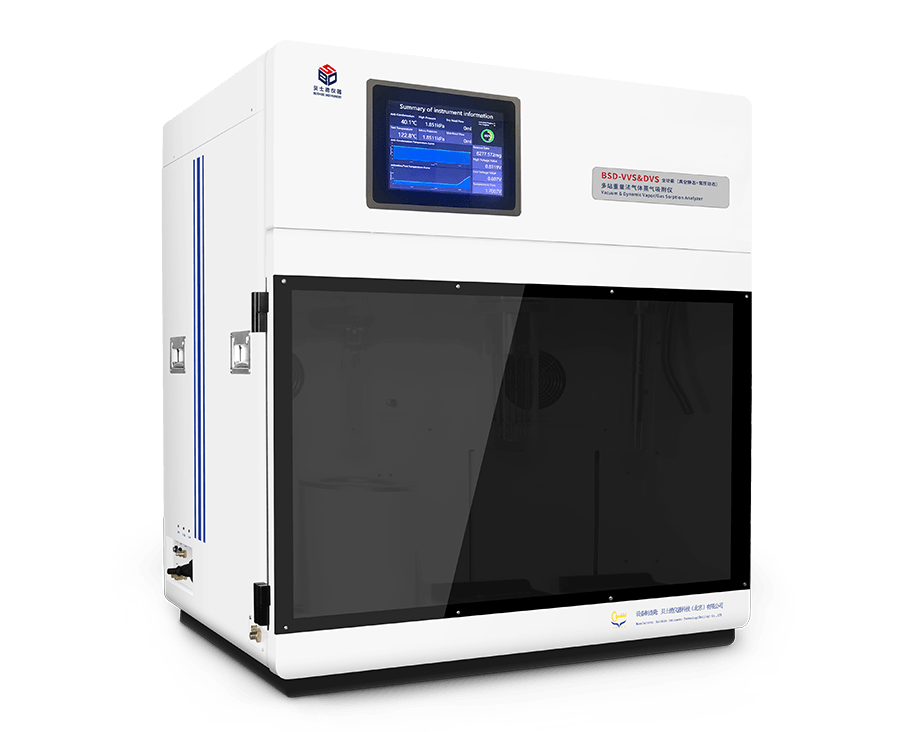
The Gravimetric Sorption Analyzer accurately measures the adsorption and desorption behavior of samples by directly weighing mass changes in real time before and after adsorption, under controlled relative partial pressures. Using a high-precision microbalance, it offers superior accuracy compared to volumetric methods, eliminating common sources of error such as temperature-induced zone distribution and non-ideal gas corrections.This analyzer overcomes the limitations of volumetric methods by enabling real-time, isobaric adsorption rate measurement and providing precise data on adsorption kinetics, which are essential for understanding material behavior.The BSD Dynamic Gravimetric Vapor Sorption Analyzer enhances this functionality with high throughput capabilities, allowing for the simultaneous analysis of up to 8 samples. Its fully automated cyclic testing feature significantly boosts laboratory efficiency, reducing the need for repetitive tasks and freeing researchers to focus on more complex analyses.

facebookLinkedintwitterskypewhatsapp
img
File not exist! Data Sheet

Key Features

Feature Icon

High Throughput

4 or 8 analysis positions; Simultaneous test;

Feature Icon

Automation

Automatic and Fast switch from activation to adsorption test

Feature Icon

Microbalance Resolution/Range

1ug/5000mg, 0.1ug/500mg optional

Feature Icon

Balance Auto Calibration

Automatic calibration before every test

Feature Icon

Auto Cyclic Test

Repeated test to learn material durabilty and lifetime evaluation

Feature Icon

Thermostatic Pipeline

~70℃ (optional 80℃), accuracy 0.1℃;

Feature Icon

Programmed heating

32-stage programmed heating to prevent pipeline contamination

Feature Icon

Blank position background Subtraction

Measure mass influence of background buoyancy for system subtraction calculation

Feature Icon

Multi sampels performance comparison

Multi sample simultaneous test under same environment

Specifications

ModelBSD-DVS

(Dynamic Method)

FunctionAdsorption-desorption Isotherms
Isobaric adsorption kinetics ( adsorption rate) Analysis
Fully automatic adsorption cycle life evaluation
Analysis Positions4 or 8 analysis positions;
Simultaneous analysis of multiple analysis positions in the same background environment
Microbalance Resolution/RangeIndustrial microbalance, 1ug/5000mg, 1ug/10000mg (0.1ug/500mg optional);
Organic Vaporyes
Non-Corrosive Gasyes
Corrosive gasyes
Auto-Switch Furnace and Waterbath (Optional)Fully automatic switching between heating furnace and thermostatic water bath, Fast switch from activation to adsorption test
Auto Cyclic Test (Optional)Automatic cyclic test of repeated adsorption and desorption to learn material durabilty and lifetime evaluation
Adsorption chamber temperatureConstant temperature bath, -5℃~120℃, accuracy ±0.1℃;
Thermostatic Pipeline~70℃ (optional 80℃), accuracy 0.1℃;
Steam generationBubbling method
Humidity0%~97.5% P/P0
Reagent tube120ml(380ml optional)
Sample ActivationAtmospheric pressure purge degassing
Room temperature ~ 250℃, accuracy ±0.1℃;
Programmed heating32-stage programmed heating to prevent pipeline contamination ;
Visual Process UIVisual information of real-time sample weighting, accurately judge whether the sample is completely degassed;
Buoyancy correctionMode 1: Buoyancy calculation mode (default); Mode 2: Blank buoyancy background subtraction mode; Mode 3: Background subtraction curve mode;
Blank position background SubtractionMeasure blank position to learn real influence of background buoyancy and for system subtraction calcuation;
Vapor removalPurging
Optional Molecular pump/
Segmental pressure measurement/
Pneumatic vacuum flapper valve/
img

Simultaneous Analysis of 4 or 8 Samples

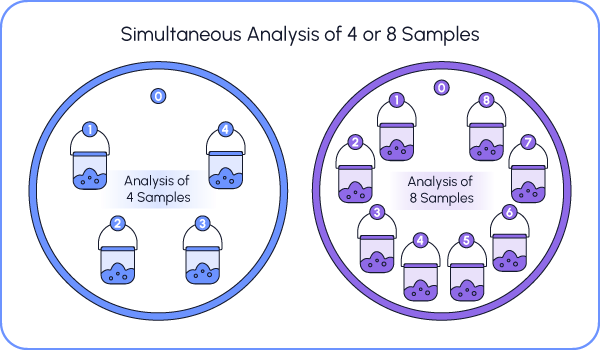
The analyzer is designed for high throughput, offering 4 or 8 analysis positions to enable simultaneous analysis of multiple samples. With all analysis positions housed within the same adsorption chamber, the system ensures that each sample is tested under identical environmental conditions, allowing for direct and reliable comparison of sample performance. This configuration maximizes efficiency and provides excellent cost efficiency.

img
img

Automatic Cyclic Test

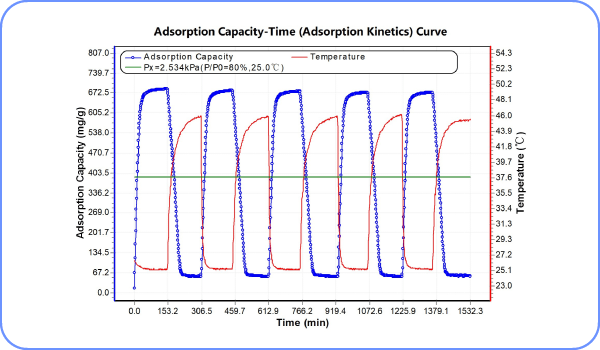
Researchers often perform multiple cycles of adsorption and desorption tests to assess material durability and predict service life. However, this process is time-consuming and labor-intensive, requiring repeated manual testing. To address this challenge, our R&D team has developed an innovative solution that enables rapid switching between activation and testing phases, while also automating the multiple cycles of repeated adsorption and desorption. This system eliminates the need for manual intervention, streamlining the testing process and providing valuable, long-term data on material durability and performance.

img
img

Background Buoyancy Measurement

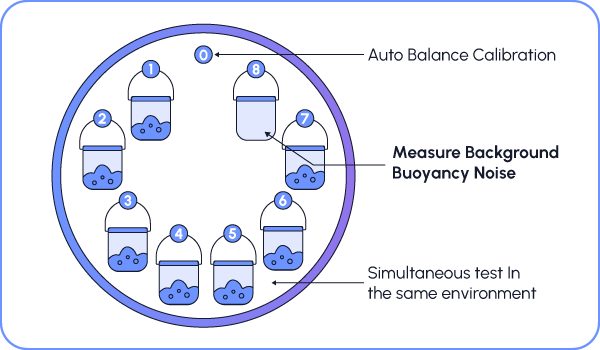
The BSD Gravimetric Sorption Analyzer offers two advanced modes for buoyancy subtraction, enhancing accuracy and precision in measurements. In addition to theoretical calculations, the system supports direct background buoyancy measurement at a blank position. This allows for real-time correction of the calculation using either the blank position data or curve subtraction. The direct background measurement at the blank position provides higher precision compared to theoretical estimates, making this an innovative and unique feature of the BSD design.

img

Other Features

The system integrates an activation furnace and thermostatic water bath into a single unit, enabling seamless automatic mode switching. This feature allows for quick testing immediately after material activation.

The system uses high-precision MFCs for precise control of gas and vapor concentrations.

The entire pipeline is maintained at a constant temperature of -70°C ± 0.1°C, ensuring optimal thermal conditions during testing.

High-precision imported mass flow controllers (MFCs) allows for precise humidity control, with a range of 0-97.5% relative humidity (P/P0), ensuring accurate environmental conditions for testing.

This optional feature enables the recovery of valuable organic vapor solutions, improving efficiency and reducing waste.

The system supports dry gas purging.

A 32-step heating process ensures controlled activation, preventing samples from being blown into the pipelines, and allowing for easy monitoring of each activation stage.

Typical Cases & Paper Citation

Image
Image
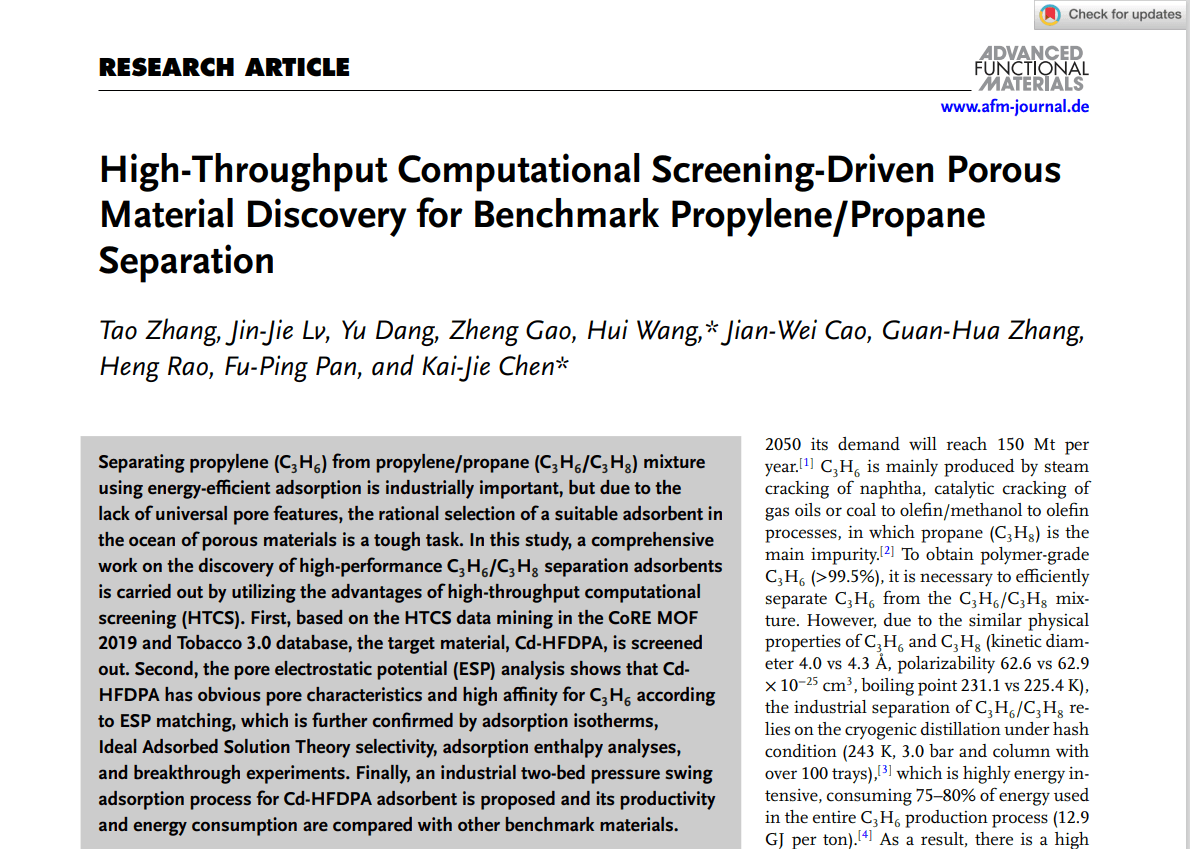
High-Throughput Computational Screening-Driven Porous Material Discovery for Benchmark Propylene/Propane Separation Tao Zhang, Jin-Jie Lv, Yu Dang, Zheng Gao, Hui Wang,* Jian-Wei Cao, Guan-Hua Zhang, Heng Rao, Fu-Ping Pan, and Kai-Jie Chen*

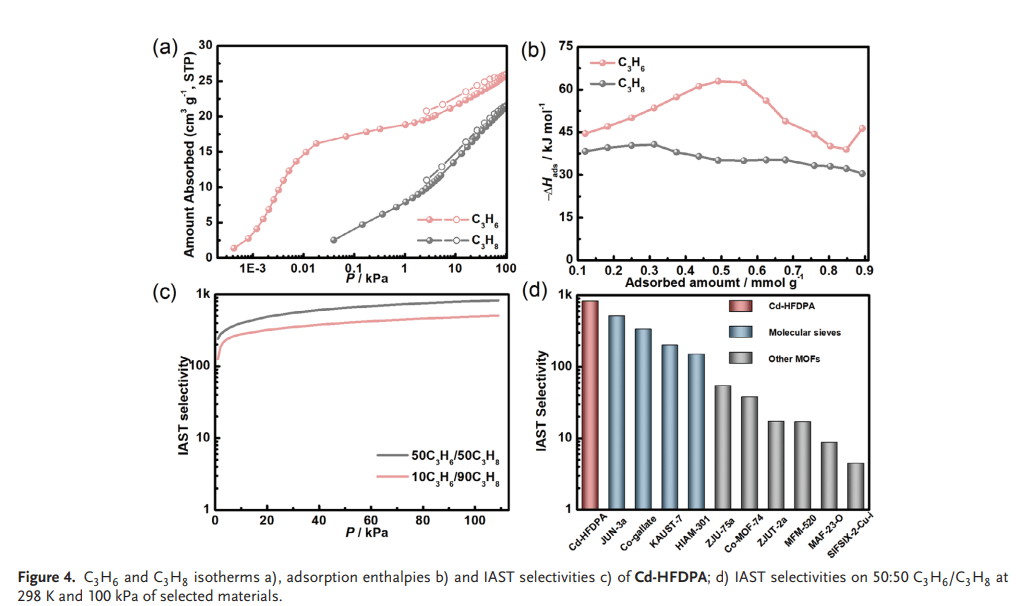
Separating propylene (C3H6) from propylene/propane (C3H6/C3H8) mixture using energy-efficient adsorption is industrially important, but due to the lack of universal pore features, the rational selection of a suitable adsorbent in the ocean of porous materials is a tough task. In this study, a comprehensive work on the discovery of high-performance C3H6/C3H8 separation adsorbents is carried out by utilizing the advantages of high-throughput computational screening (HTCS). First, based on the HTCS data mining in the CoRE MOF 2019 and Tobacco 3.0 database, the target material, Cd-HFDPA, is screened out. Second, the pore electrostatic potential (ESP) analysis shows that CdHFDPA has obvious pore characteristics and high affinity for C3H6 according to ESP matching, which is further confirmed by adsorption isotherms, Ideal Adsorbed Solution Theory selectivity, adsorption enthalpy analyses, and breakthrough experiments. Finally, an industrial two-bed pressure swing adsorption process for Cd-HFDPA adsorbent is proposed and its productivity and energy consumption are compared with other benchmark materials.