Home / Blog / Unlocking Surface Secrets: The Working Principle and Applications of the BET Adsorption Analyzer
Unlocking Surface Secrets: The Working Principle and Applications of the BET Adsorption Analyzer
09 12 月, 2025From: BSD Instrument
What is the BET Method?
How Does a BET Adsorption Analyzer Work? (The Principle)
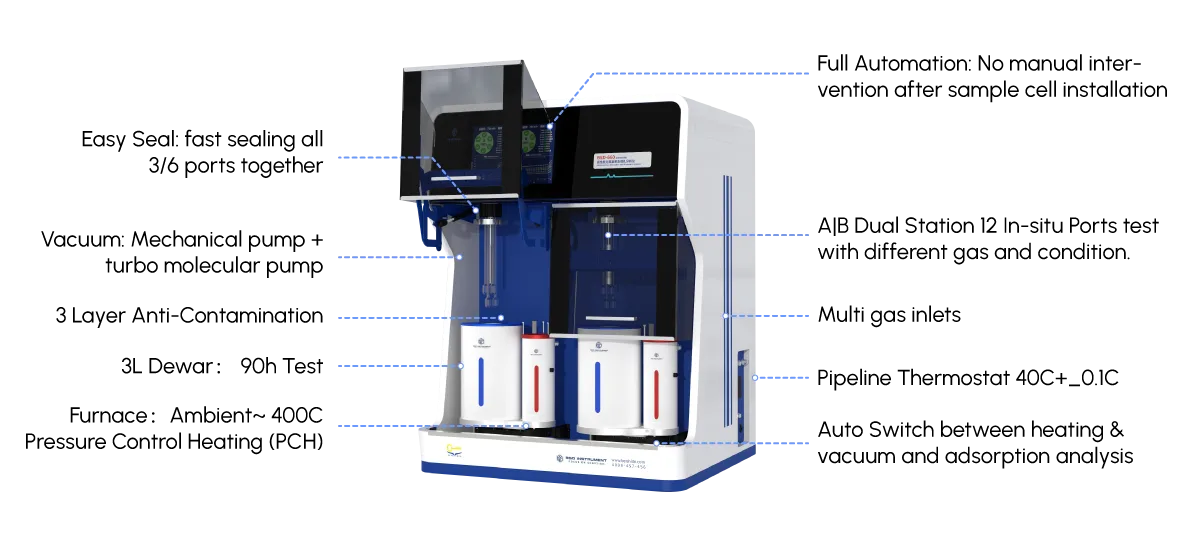
Sample Preparation: The material is first heated under vacuum to remove any contaminants or pre-adsorbed gases, ensuring a clean surface for measurement. Adsorption (Gas Uptake): The prepared sample is placed in a temperature-controlled chamber (the sample cell). It is then dosed with precise pulses of nitrogen gas. As the gas pressure increases, nitrogen molecules begin to adsorb onto the available surface sites of the material, much like dust settling on a table. The instrument measures the volume of gas adsorbed at various equilibrium pressures. Desorption (Gas Release - Optional): In many modern analyzers, the process is reversible. By reducing the pressure, the adsorbed gas is desorbed, allowing for the analysis of pore size distribution as well. Data Analysis & The BET Equation: The magic lies in analyzing the data. The volume of gas adsorbed is plotted against the relative pressure (P/P₀). The resulting graph typically shows an initial linear region. The famous BET equation is fitted to this linear section. From the slope and intercept of this line, we can directly calculate the monolayer capacity—the total volume of gas needed to form a single, complete layer over the entire surface of the sample. Calculating Surface Area: Knowing the monolayer capacity and the cross-sectional area of a single nitrogen molecule, the instrument software calculates the total specific surface area of the sample in square meters per gram (m²/g).
Key Application Fields
Catalysis & Chemical Engineering: Catalysts work by providing a large surface area for reactions to occur. The BET surface area is a primary indicator of catalyst activity and efficiency. A higher surface area generally means more active sites and a more effective catalyst. Porous Materials & Filtration: Activated carbon for water filters, zeolites for molecular sieves, and MOFs (Metal-Organic Frameworks) for gas storage rely on their intricate pore structures. BET analysis helps characterize these pores and optimize their performance for separation and storage. Pharmaceuticals: The dissolution rate and bioavailability of many drugs are directly influenced by the surface area of the active pharmaceutical ingredient (API). Controlling surface area during manufacturing ensures consistent drug performance and efficacy. Energy Storage: The capacity of batteries and supercapacitors is heavily dependent on the surface area of electrode materials. Nanomaterials with high surface areas are engineered to maximize energy storage and charge/discharge rates. Coatings & Adhesives: The performance of paints, varnishes, and adhesives depends on how well they wet and adhere to a surface. Measuring the substrate's surface area helps in formulating products with optimal coverage and bonding strength. Nanotechnology: As materials enter the nanoscale, surface-area-to-volume ratio becomes the dominant property. BET analysis is fundamental for characterizing nanoparticles, nanotubes, and other nanostructures.
Conclusion
Share:


Our Latest Blog & Articles
Stay updated with our latest news. Discover new product launches, innovative technologies, and upcoming events. Join our community and stay informed about all things lab equipment.
-
16 9 月, 2026
Organic Vapor Adsorption on Activated Carbon: Pore Structure, Surface Chemistry, and Breakthrough Behavior
-
25 8 月, 2026
Overcoming Thermal Transpiration Effects in Volumetric Adsorption Analyzer for Ultra-Micropore Characterization
-
21 7 月, 2026
Integrating Machine Learning Algorithms with Micropore Analyzer Data for Rapid Pore Size Distribution Prediction
-
26 6 月, 2026
Gas Sorption vs. Mercury Intrusion: Which Pore Size Analyzer Technique Is Right for You?